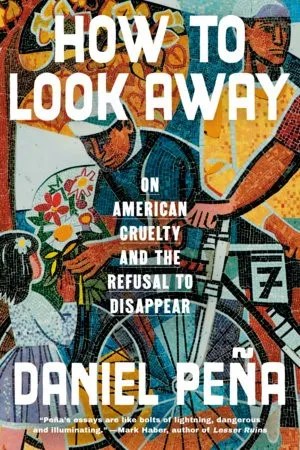
How to Look Away: On American Cruelty and the Refusal to Disappear by Daniel Peña caught my attention because I’ve been thinking lately about how, in a time with massively increased exposure to the suffering of others, Americans’ attention to systemic violence seems at least as limited as ever. And while these essays do address America’s, and especially white America’s, ability to look away, what really gripped me was their exploration of the looking that we do engage in.
Peña’s prose is impressionistic and immersive, anchored in the author’s childhood memories of biking through his native Texas Hill Country or vivid reconstructions of time spent with Mexican deportees. While there are scattered references throughout the essay collection, Peña focuses less on philosophical or historical frameworks and more on the sensory and emotive. By doing so, he pulls us in close as he, a college professor, is detained by ICE then dismissed by a white colleague. He invites us into the creativity and loneliness of Diego, who was deported from the U.S. and lives in Mexico City under the ire of his young American daughter. It’s easier to look away from a news clip or an Instagram story. It’s harder to look away from a man who builds artisan doll houses to send money to a family who can’t understand his absence.
But more interesting than Peña’s request that we witness the individuals who populate his recollections, which the author himself claims are faithful to the real capital-T Truth of the matter rather than necessarily to actual fact, is his often less explicit critique of American voyeurism—his claim that our fear isn’t of looking but of intervening.
To anyone who has had a pulse at any point in the last decade or so, it’s obvious that middle-class white Americans hunger for violence. True crime is the second most popular genre across podcasts and audiobooks and in audiobooks is second only to fictional crime stories. Netflix continues to churn out documentary and drama series about real-life killers. In “The Disappeared Body” Peña plays with this morbid fascination when he shares his own encounter with the perpetrator of the 2015 Lafeyette, Louisiana, movie theater shooting, to explore the intent of violent white men to secure a permanent place of power over the rest of us. Elsewhere in the collection, he deprives us of the crime scene when a woman from his story is murdered. He asks us to witness the lives of immigrants, deportees, and all Black and brown Americans but prevents the voyeurism that he says “affirm[s] our illusion of power (I have the privilege of doing the looking).” “I think at our core we imagine our voyeurism will save us. If we look, we survive;” we separate ourselves from the “them,” the Other upon whom violence is enacted.
Peña doesn’t let white readers off easy by giving them a checklist, but he also doesn’t let the cruelty he depicts strip Black and brown Americans of their futures. He watches birds as he hears tell of other Americans of color being punished for the same. He buys a kit for a squirrel-sized picnic table to support a victim of pandemic layoffs, and he builds and mounts that picnic table despite the derision of a white neighbor. And in the midst of a global pandemic, he joins more than sixty thousand people in Houston as they accompany George Floyd’s family to city hall. And he sees how everyone around him “has converted that rage into light.”
Further Reading
- An Undocumented War: Inside Deportation’s Machinery of Violence
- Everyone Who Is Gone Is Here by Jonathan Blitzer
- The Book of Unknown Americans by Cristina Henríquez


Leave a Reply